Every nurse, paramedic, and doctor you will ever meet practiced on a manikin first. Someone built that manikin's heartbeat, ran the monitors, staged the wound, and hit record. That someone is a Simulation Operations Specialist — and almost nobody knows the job exists.
A free public education resource of the University of the Virgin Islands Medical Simulation Center
You do not need to decide today
This page exists to help you explore, not to recruit you into a career that may not fit. Simulation operations can be creative, technical, social, repetitive, high-pressure, and genuinely funny — sometimes in the same afternoon.
It is also one of the few healthcare careers you can enter without a clinical license. You do not have to want to be a nurse or a paramedic to belong in a simulation center.
Job titles, education requirements, and hiring rules differ by employer, school, and country. Confirm local expectations before enrolling in a program or applying for work.
The honest version
What Simulation Operations Specialists really do
Start with Alejandro.
Alejandro is sixteen. He was riding his bicycle home when a car door opened in front of him. He hit the pavement hard, and by the time the ambulance reaches him he is pale, breathing fast, and frightened. Over the next hour a paramedic crew, an emergency team, and a surgical unit will each make decisions that change what happens to him.
Alejandro is not real. He is a training scenario, and a room full of students will care for him this morning.
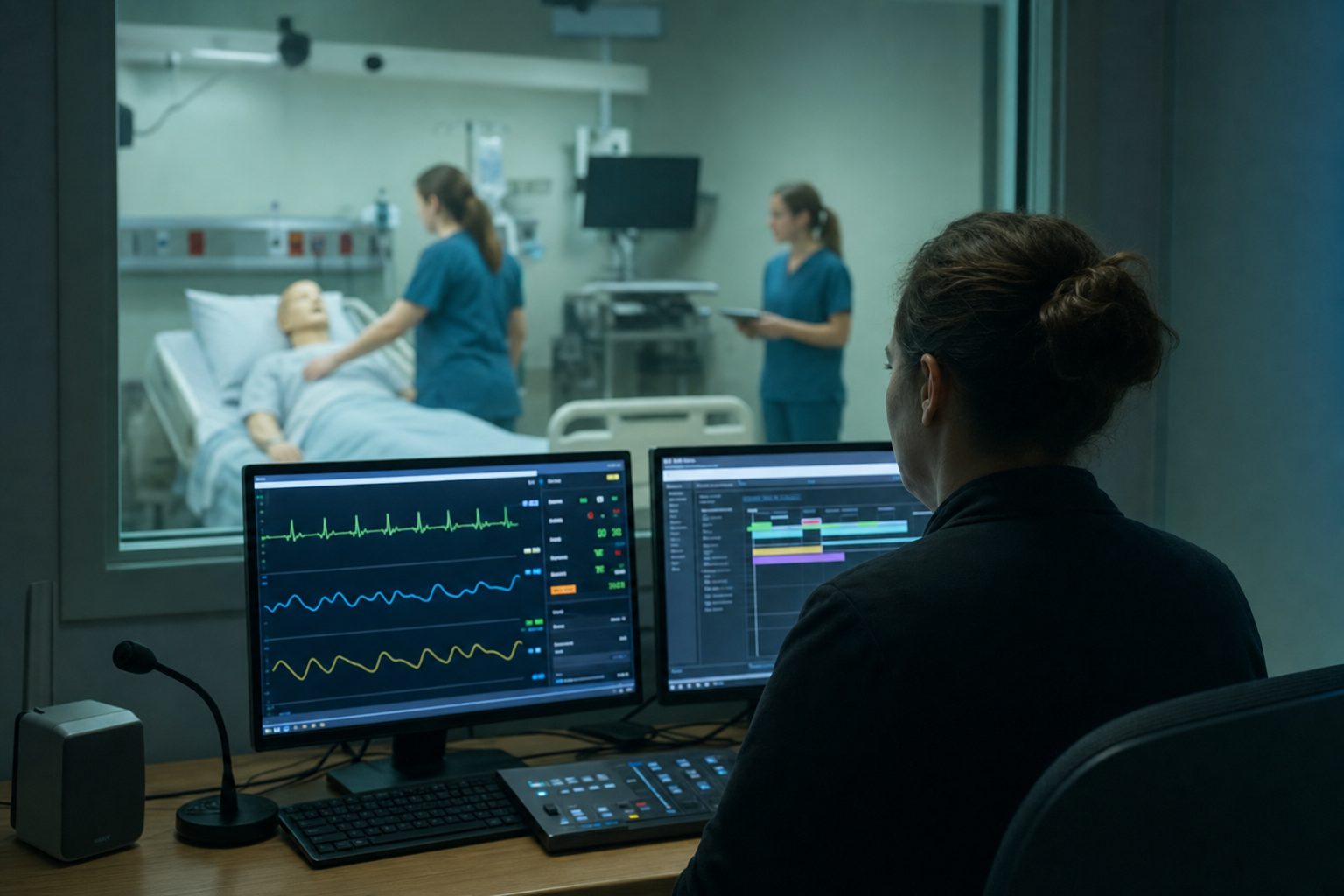
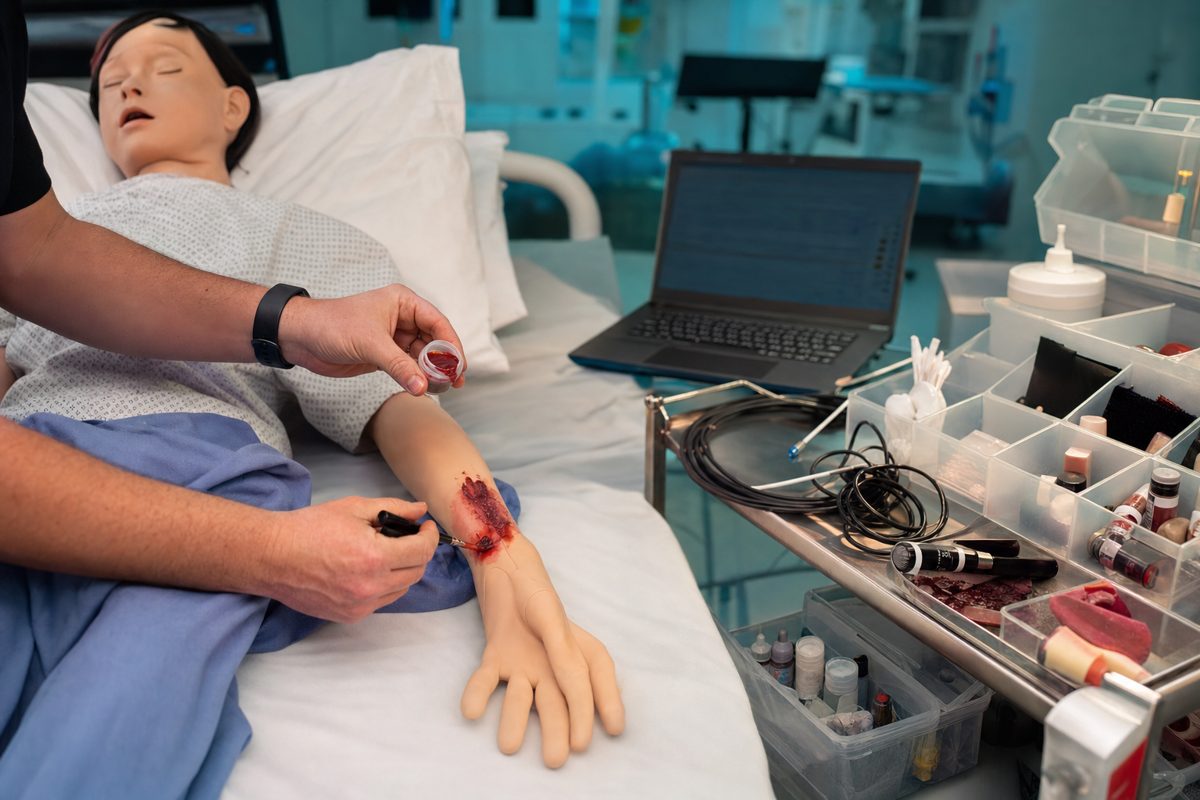
But somebody had to make him real enough to matter. Somebody staged the road rash on his forearm, set his heart rate to climb exactly when the bleeding gets missed, gave him a voice through a hidden speaker, positioned the cameras that will show the team what they did, and tested every piece of it at six in the morning so nothing failed at nine. Somebody stayed calm in the control room when a student froze.
That is the job on this page. When those students meet a real sixteen-year-old on a real road, part of what they know will have come from a morning with Alejandro — and from the person who built him.
Simulation technology specialists are responsible for the set-up, operation, and maintenance of the simulation environment, and often support education, audiovisual systems, and IT as well (SimGHOSTS Capability Framework).
Work people notice
Run the manikin live — the heart rhythm, the breathing, the voice, the crash
Operate scenario software and patient monitors from the control room
Build and program new scenarios with the educators who teach them
Stage realistic wounds, blood, and injuries with moulage makeup
Record sessions and pull the video clips used in debriefing
Solve problems live, in front of a room, without stopping the session
Work people forget
Set up and break down rooms — before and after every session
Clean manikins, replace skins, change batteries, and chase software updates
Track inventory, order supplies, and manage equipment repairs
Run cable, mount cameras, and troubleshoot audio nobody can hear
Work early mornings before class and late nights before big events
Be the calm person when a $90,000 manikin freezes two minutes before a session
A career that lives behind the glass
Simulation operations is a support role in the best sense. Your name is not on the certificate. Your work shows up as a student who felt the scenario was real, hesitated, made a mistake in a room where nobody could be hurt, and did it correctly the next time.
If you need public credit to feel valued, this is a hard job. If you get satisfaction from a session that ran flawlessly because you planned for the three things that could break — this may be your career.
Most of the job happens before anyone walks in the room.
You may already be halfway there
Where simulation operations specialists come from
There is no single degree for this job and no standard pipeline into it. People arrive from technology, from the arts, from the field, and from healthcare — and the ones who succeed usually bring one strong skill and a willingness to learn the rest. If you are a career changer, read this section first.
IT & computer support
You already fix what nobody else can
Networking, imaging machines, software updates, help-desk troubleshooting under pressure. Simulation technology operations is the largest single slice of the certification exam at 35%, and it is mostly this.
Audiovisual & live production
You already run a live show
Cameras, mixers, microphones, cabling, recording, and staying calm when something fails in front of an audience. A simulation session is a live production with a debriefing attached.
Military & veteran
You already trained people to standard
Training systems, combat medicine, range and exercise control, equipment accountability, checklists, after-action review. Debriefing a simulation is an after-action review with different vocabulary.
EMS, nursing & allied health
You already know what real looks like
You can tell when a scenario is believable and when it is not, and you speak clinical language fluently. Many centers hire clinicians who would rather build the training than deliver the care.
Theater, film & makeup
You already build the illusion
Staging, props, lighting, effects makeup, and directing people through a scene. Moulage — the wounds, blood, and injuries that make a scenario land — is special-effects makeup with a clinical purpose.
Education & operations support
You already keep programs running
Scheduling, inventory, purchasing, learning-management systems, classroom technology, and coordinating people who all want the same room. A center lives or dies on this work.
Almost nobody arrives with all of it. Employers hire for one strong area and train the rest — which is why the fit quiz below shows you where you would start, not whether you qualify.
Choose the answer that is most honest today. This is not a test and there is no failing result. Technical skill, confidence, and comfort with pressure all improve with practice — what this shows you is where you would start.
The four areas scored here — simulation technology, educational principles, safety, and general professional competencies — come from a published competency framework for non-clinical simulation operations specialists, built specifically for people entering with no prior clinical or simulation experience (Jagannathan et al., Cureus, 2025). This quiz is a reflection tool, not a validated assessment, and no score can predict whether you will succeed.
Look at both sides
Why people stay — and why some leave
Possible rewards
You enter healthcare without needing a clinical license
The work is genuinely varied — technical, creative, and social in the same week
You build rare, transferable skills in AV, IT, and education technology
You see the direct result of your work in how confident learners become
There is a national certification and a real career ladder
Small teams mean you grow quickly and your ideas get used
Possible challenges
Physical work: lifting manikins, moving beds, long hours on your feet
Peak-season crunch around exams, orientation, and accreditation visits
Little public recognition when everything goes right
Small departments can mean limited promotion inside one center
Equipment budgets and repair delays are outside your control
Continuing education is required to keep certification current
Do not choose this field only because you like technology. Consider whether you also value teaching, patience, teamwork, and doing careful work that other people depend on.
Prepare while you are still in school
Your roadmap into simulation operations
Opportunities vary widely by region and school. Treat this as a planning guide, not a list of universal requirements.
01
Find out what the job actually is
Any grade · costs nothing
Ask whether a nearby college, hospital, or university has a simulation center — then ask for a tour
Talk to a simulation technician, nursing instructor, or EMS educator about a normal week
Watch behind-the-scenes videos of simulation centers, not just dramatic scenario clips
Learn the difference between the educator, the operations specialist, and the standardized patient
02
Build the skills that transfer
Grades 9–12 · the highest-value years
Take health science, biology, and anatomy if your school offers them
Take anything technical: computer support, networking, AV production, theater tech, robotics
Get CPR or First Aid certified — it is inexpensive and it signals seriousness
Join theater tech, media crew, or esports production — running a live show is the same skill
Practice explaining things to people who do not already understand them
03
Get into the room
Grades 11–12 and beyond
Volunteer to be a scenario helper, room runner, or actor at a simulation event or health fair
Ask about student worker jobs at a college simulation lab — many hire undergraduates
Consider an EMT certificate; it teaches clinical vocabulary fast and opens doors
Keep a simple log of every session you help with. This becomes your resume.
04
Enter the field
After high school
There is no single required degree. People arrive from IT, AV, theater, EMS, nursing, and military medicine.
Many employers ask for an associate degree or two years of relevant experience; some ask for a bachelor's
Join the professional community early — SimGHOSTS membership is about $95 per year
05
Certify and grow
After about two years in the role
Earn the CHSOS credential once you meet the experience requirement
Move toward lead specialist, simulation manager, or center operations director — see the career ladder
Advance to CHSOS‑A, or move sideways into education, IT, or vendor training roles
Where the career goes
This is a ladder, not a single job
Simulation operations is an entry point, not a ceiling. The scope of the work widens in a predictable way: you start responsible for equipment, then for sessions, then for programs, then for budgets and people. Titles vary by employer — what changes underneath them does not.
01
You are responsible for the equipment
Set up and break down rooms, run the manikin during someone else's scenario, keep the inventory straight, and fix what breaks. You are learning the vocabulary and the building.
You run scenarios independently, build new ones with faculty, manage the AV and recording, train student workers, and are trusted to solve problems live without stopping the room. This is where the CHSOS credential becomes reachable.
Scheduling across departments, purchasing and vendor relationships, onboarding and evaluating other staff, accreditation documentation, and designing how simulation gets delivered rather than just delivering it.
Senior Simulation Operations Specialist · Simulation Program Coordinator · Lead Specialist
04
You are responsible for the budget and the people
Capital planning, grant-funded equipment, staffing, partnerships with hospitals and agencies, and answering to accreditation bodies for the whole center.
Simulation Center Manager · Director of Simulation Operations · Educational Technology Manager
05
Or you take the skills somewhere else entirely
The same experience moves sideways into simulation vendor roles — installation, application specialist, technical training, sales engineering — and into healthcare education technology, emergency-management exercise design, and independent consulting.
Reported salaries for healthcare simulation technicians in the United States generally run from about $45,000 to $75,000 per year (HealthySimulation.com). A recent community college posting for a Simulation Operations Specialist listed $47,000 to $52,000 (Pikes Peak State College).
In other words, the entry rung sits near the bottom of that band and the rest of the band is the ladder above it. Movement generally follows scope: certification, then responsibility for sessions and staff, then responsibility for a program.
Only the entry figure and the overall band above are drawn from published sources. Because this occupation has no federal classification code, there is no national wage survey for it — treat any single number, including these, as a starting point for local research rather than a benchmark. Ask a center in your own region what they actually pay.
The credential
CHSOS, explained honestly
The Certified Healthcare Simulation Operations Specialist credential is offered by the Society for Simulation in Healthcare. It is not an entry ticket — you must already be working in the role to sit for it.
2 yearsOf simulation operations experience required before you can apply, plus a bachelor's degree or an accepted equivalency
115Multiple-choice questions in a 2-hour exam — 100 scored, 15 unscored pilot items
$395Application fee for SSH members, including one exam attempt. $495 for non-members.
Healthcare Simulation Practices, Principles, and Procedures
25%
Professional Role — behavior, capabilities, and leadership
15%
Concepts in Instructional Design as applied to simulation
15%
Concepts in Healthcare as applied to simulation
10%
Weights from the CHSOS Examination Blueprint, 2024 Version. Fees, exam length, and eligibility from the CHSOS Handbook and SSH eligibility page. Older prep materials still circulate with superseded domain weights — always check the blueprint date. Certification lasts three years and renews with 45 continuing professional development credits.
The advantage nobody mentions
Why your school's career software has never heard of this job
This occupation does not exist in the U.S. career classification system. A keyword search of O*NET for "healthcare simulation" returns no simulation operations or technician occupation, and the CHSOS credential record lists no linked occupations at all (O*NET certification record 11260-B).
Because school career software, interest inventories, and aptitude platforms all draw from that same database, no career quiz you take in a counselor's office will ever suggest this job to you. Your counselor is not withholding it. It is genuinely not in the system.
That is a gap in the paperwork, not a sign the career is not real — simulation centers hire for these roles continuously, and every nursing program, medical school, hospital education department, and EMS academy needs someone doing this work.
Read that as an opportunity, because that is what it is
You are competing against a small field. Most applicants for any given opening have never heard of the role either. Candidates who can explain what a simulation center actually does stand out immediately.
Nobody expects a matching degree, because none exists. Employers hire on demonstrated skill and attitude, which is unusually good news if your background is IT, AV, theater, the military, or EMS.
The field is still being defined. The core competency frameworks were published in 2019, 2023, and 2025. People entering now help write the standards rather than inherit them.
Demand is structural. Accreditation and licensure increasingly require simulation-based training, and someone has to operate it.
The honest caveat: no classification code also means no official national job-growth or wage projection. Nobody can tell you how fast this field is growing, including this page. Verify locally — search your region's hospital and college job boards for "simulation" and see what comes back.
Three things you can do this week
Ask one question
Email or call the nearest college or hospital simulation center and ask whether you can tour it. Most say yes. Almost nobody asks.
Save or print your fit quiz result, note the areas marked “worth growing,” and pick one to work on this term. That is a more useful plan than picking a major.
Want to see one in person?
Come stand in the control room
Reading about simulation operations is not the same as watching a manikin's rhythm change while a student decides what to do next. If you are in the U.S. Virgin Islands, the University of the Virgin Islands Medical Simulation Center hosts student tours, career-day visits, and hands-on sessions on St. Croix.
If you are somewhere else, use the same request with your nearest center — that first ask is the single highest-value thing on this page.